Hemiplecta distincta snails can be found in the north-east of Thailand, Vietnam, Laos and Cambodia. Don't know if they are in Burma. They live in a tropical forests/woodlands environment - with temperatures between 28-33C and humidity between 75-85% for most of the year. In Thailand, we suffer a 3-4 month dry (and very hot) season, between February and May. Temperatures - certainly in Bangkok, during this period can be between 28-36C, and humidity as low as 40%. I would guess that in the forests - humidity would be higher - 60-70% during this period. I've heard from many accounts that they estivate during this period - and that's when they are collected - cooked and eaten - no bitterness, just delicious (so they say)!! Keeping the level of humidity high is critical if you are raising them - as I sadly found when I first started farming them. Providing good organic soil is also important.
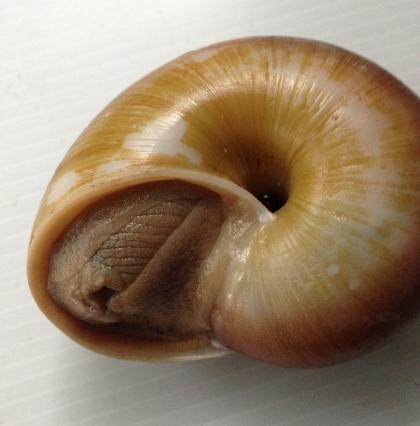
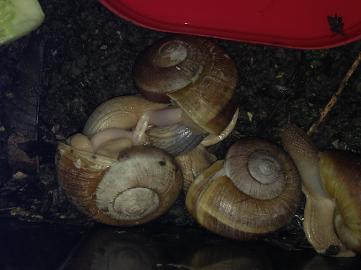
Burrowed under dead leaves and rotting organic vegetation for over 2 - 3 months during this hot dry weather, my guess would be that they "wake up" at the onset of tropical storms - by feeling the vibrations of the thunder, and the fall of heavy rain drops; the sudden change in air pressure from lightening strikes. This occurs towards the end of April - early May. They would then extrude their lower tentacles - their very sensitive 'smell' sensors to "sniff" the rain and the damp soil. Now awake, they would then go on a feeding binge and the adult snails would then mate (the youngsters would "watch" in awe ... or pretend to be busy playing Sudoku on their i-phones!).
Pix on the left is of a snail estivating.
.
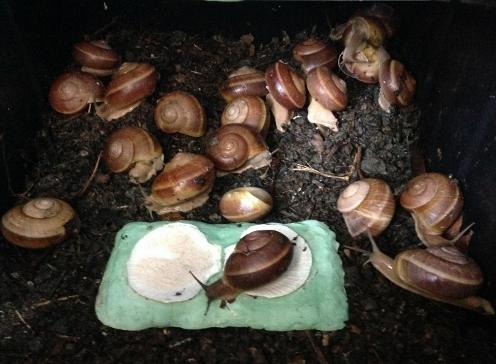
40 to 70 eggs are laid on top of the soil towards the end of May/early June - (not into little holes dug in the soil - as done by other snail varieties) just in time for the onset of the rainy season - to keep the leaves and undergrowth damp, so to eggs can develop.
Above left, you can see two snails mating (plus one, diving in for a close up selfie and another nosy onlooker!). One of the snails after 20 days and less than 12 hours of laying, has just produced a bountiful clutch of eggs ... over 80. It's more than what they say on various websites - maybe because I've been giving them a good dose of crushed and powdered snail shells (lots of hemiplecta siamesis in the orchard). Beautiful! Soon afterwards, I will remove them to a nursery bin to prevent any of the adults nibbling at the eggs for calcium! I suppose the other snail will also be laying eggs! Size of eggs - 0.56cms. Woopee! Big question now is - egg mortality rate ?? More info on this subject if you click "Hemiplecta distincta EGGS" above.
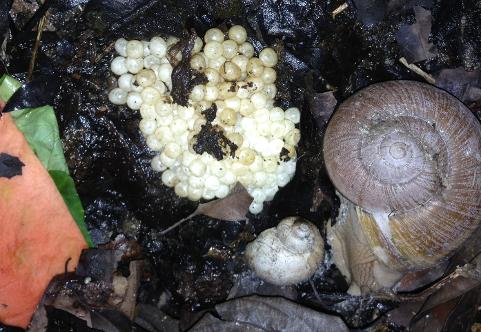
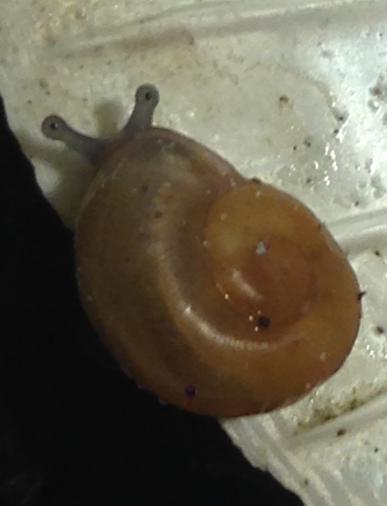
On the right, a one hour old baby snail, hatched exactly 10 days after being laid. How many will hatch out of a total of 85, we'll see. It was removed from the nursery bin as it was eating (or seemed to be) another nearby egg for the calcium.
So, regarding "keeping" these snails, I warn you that they
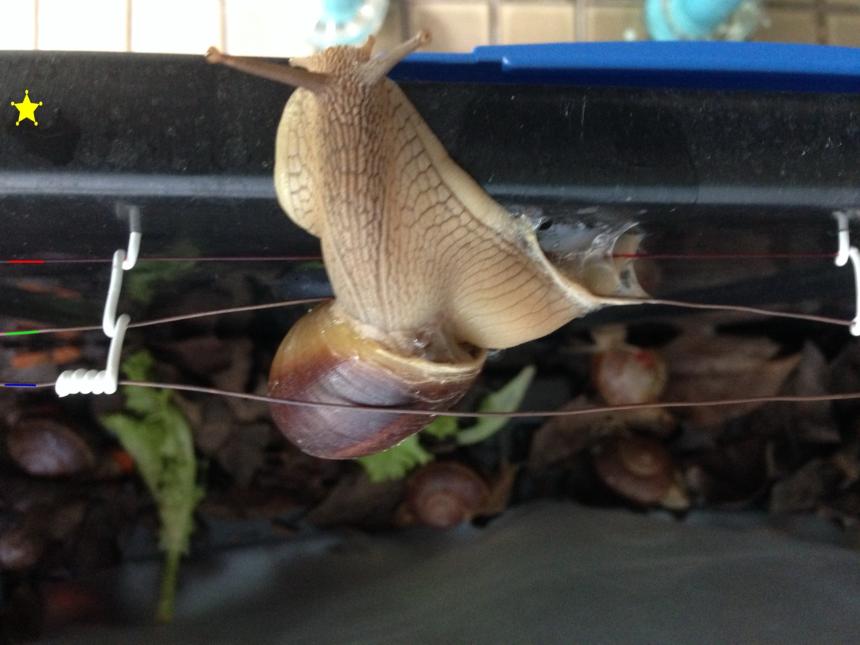
are "EXPERTS" in escaping! Using electrified fencing didn't work on the small snails - you have to use netting. They are also surprisingly strong. As you can see on the right, they will turn their shell and force it between two taut copper electric wires to get out - the black (yellow star on top left) bit is the lip of the bin. The white 'spacer' wires are 12 cms. apart. In hind sight, forget the wiring - just use netting - less troublesome.
Suggest you use large, light storage bins to start off your snailery project.These breeding aspects I will confirm, once I have witnessed them myself (and provide pixs if possible - especially if I catch them playing sudoku on the i-phone - ). If on the other hand you know of something that I don't - or am incorrect on - please email me -- I would really appreciate your input. One observation I can make (16 months since I started this venture) - based on the many 'north-eastern' people I've spoken to, is that these hemiplecta d. snails are becoming really hard to find - so much of their environment has been destroyed - through farming and new housing/industrial estates sprouting up. I guess it won't be long before this species becomes an endangered one. Anyway, I'm still enjoying managing my small snail farm - at least the snails don't bite, bark, and bitch about the food they get! Nor is the daily routine work of feeding, cleaning out the uneaten food, keeping records strenuous. Plus ... as I'm finding out, you don't have to use nappies or change them!! And they'll laugh at your jokes too! ..... What's the difference between a politician and a snail? One is slimy, a pest and leaves a trail everywhere, and the other has a shell on its back. What's the difference between Trump and a snail - a snail can't lie! Ha ha ha!.
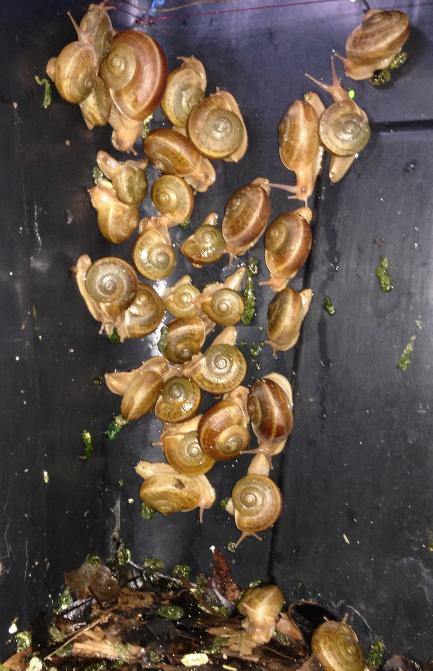
Another interesting point is when snails go into hibernation or aestivation, they will come together in the undergrowth in groups of 10, 30-40 snails - and that's called "a hood". A group "sleep over" as it were. Even during 'normal' conditions, in the mornings when I check on them - they're usually clumped around each other. Guess they're 'social' creatures - so maybe you shouldn't raise just one snail - it'll be very lonely.
Finally, at the start of this project - one of the objectives was to eat them - in butter and parsley with garlic bread! Alas, having raised them for over a year now - I kind of become rather attached to them - don't think I can boil and cook them, weird eh? So if you have read this far, and are still interested in farming this type of snail, and are looking for 'stock' ... I'm afraid I can't help you. Thai postal services, FedEx, and DHL here will NOT handle live animals ... no matter how well you pack them! Only way I guess is to carry them with you on your plane - or I post you eggs (in a disguised package). If you collect shells, I have some for sale.
Thank you for your interest in this website.